Kristina Knipe
Photographer Kristina Knipe won the Film Photo Award in 2022. valentin uhrig catches up with Kristina on her work.



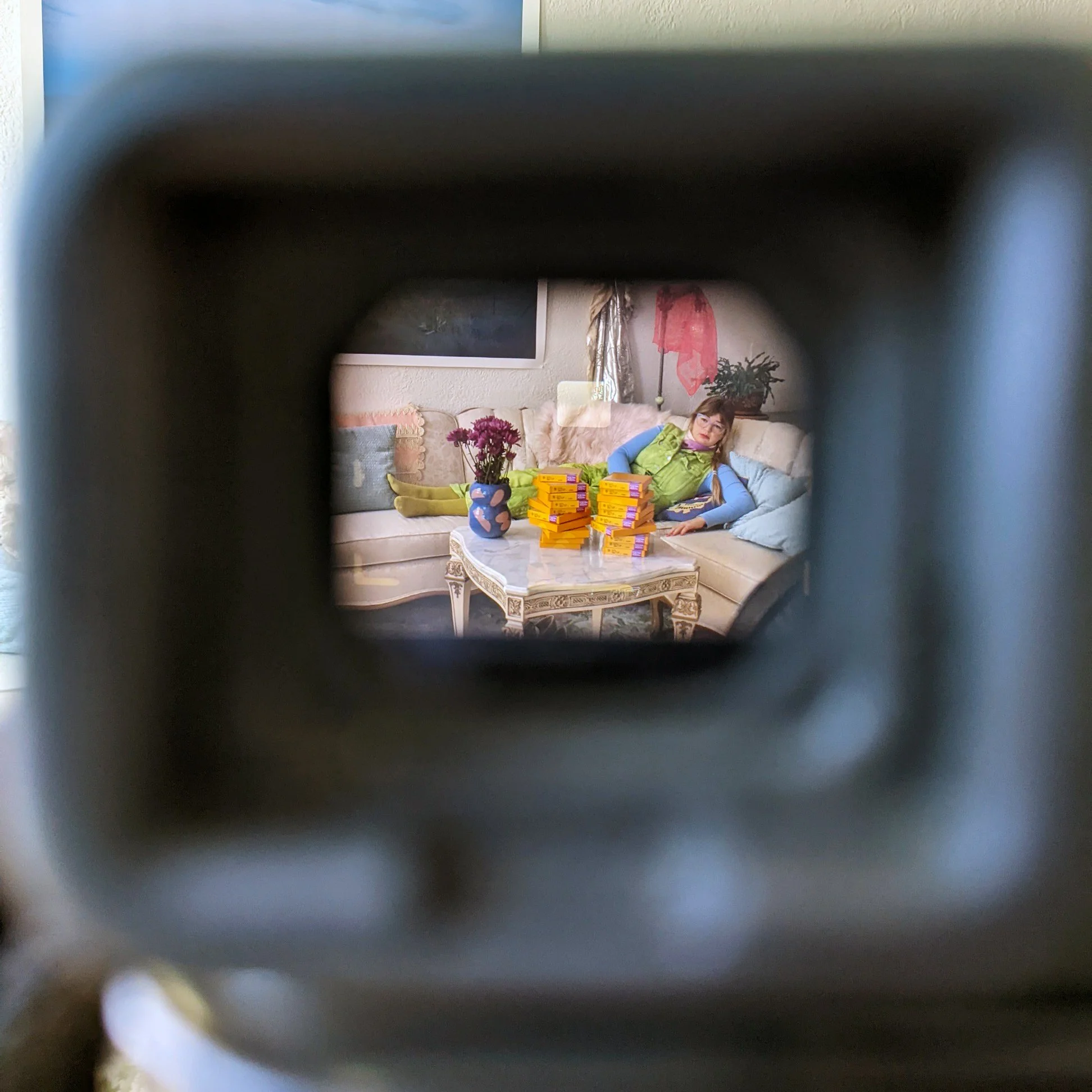
© Kristina Knipe
valentin uhrig: You said in one of your statements about your current project, Talisman, that you’re interested in exploring queer identity through mythology. I love that because queerness is often found through fantasy, escapism or mythology. I'm curious about your word choice there because that's not often one that I see used. Do you use it still to describe your work?
Kristina Knipe: I guess there are a couple ways that I think about it. I think about the mythology that a lot of people in the images connect with, about the mythology we create around ourselves and objects, or as a way to connect with objects.
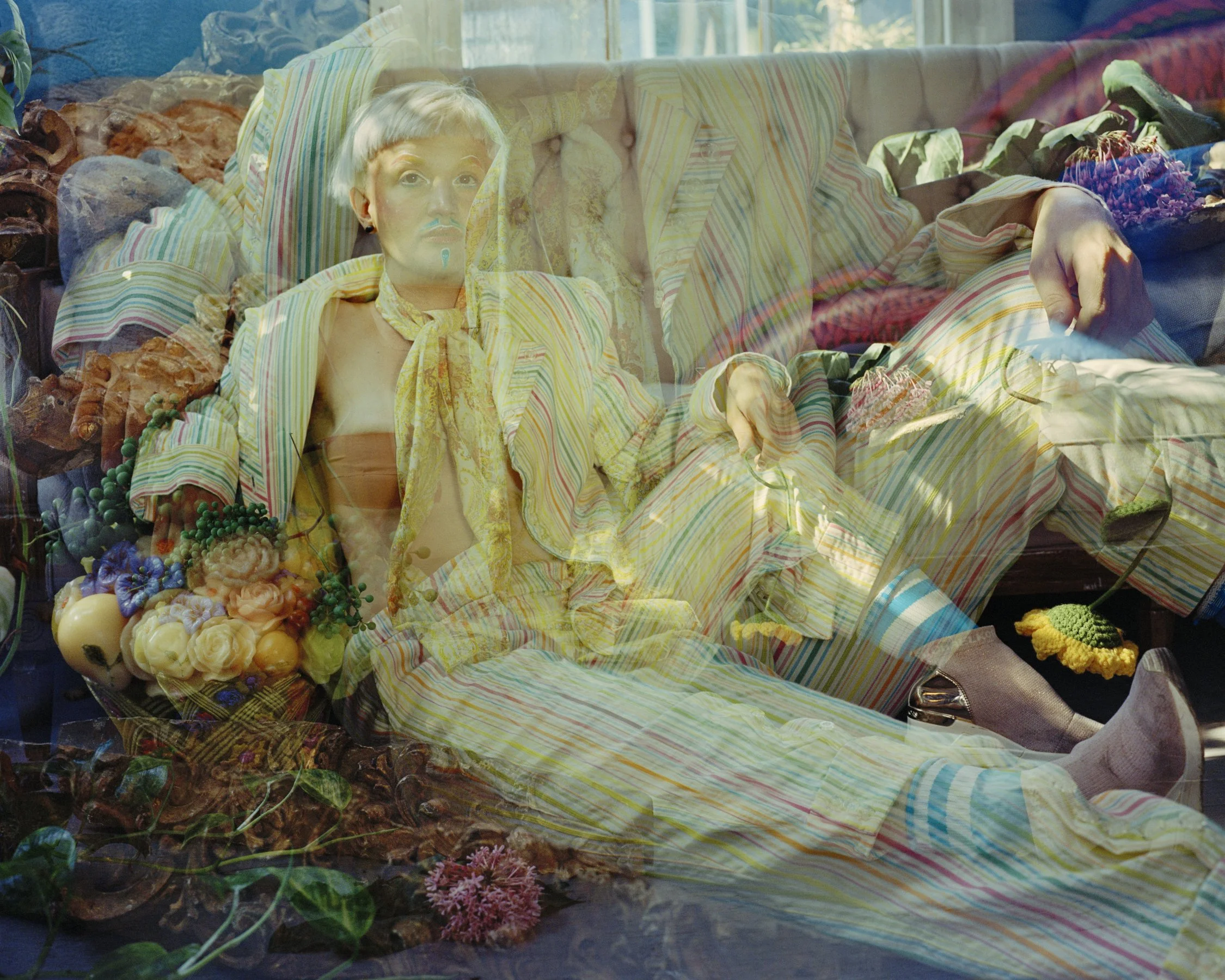
Ursula
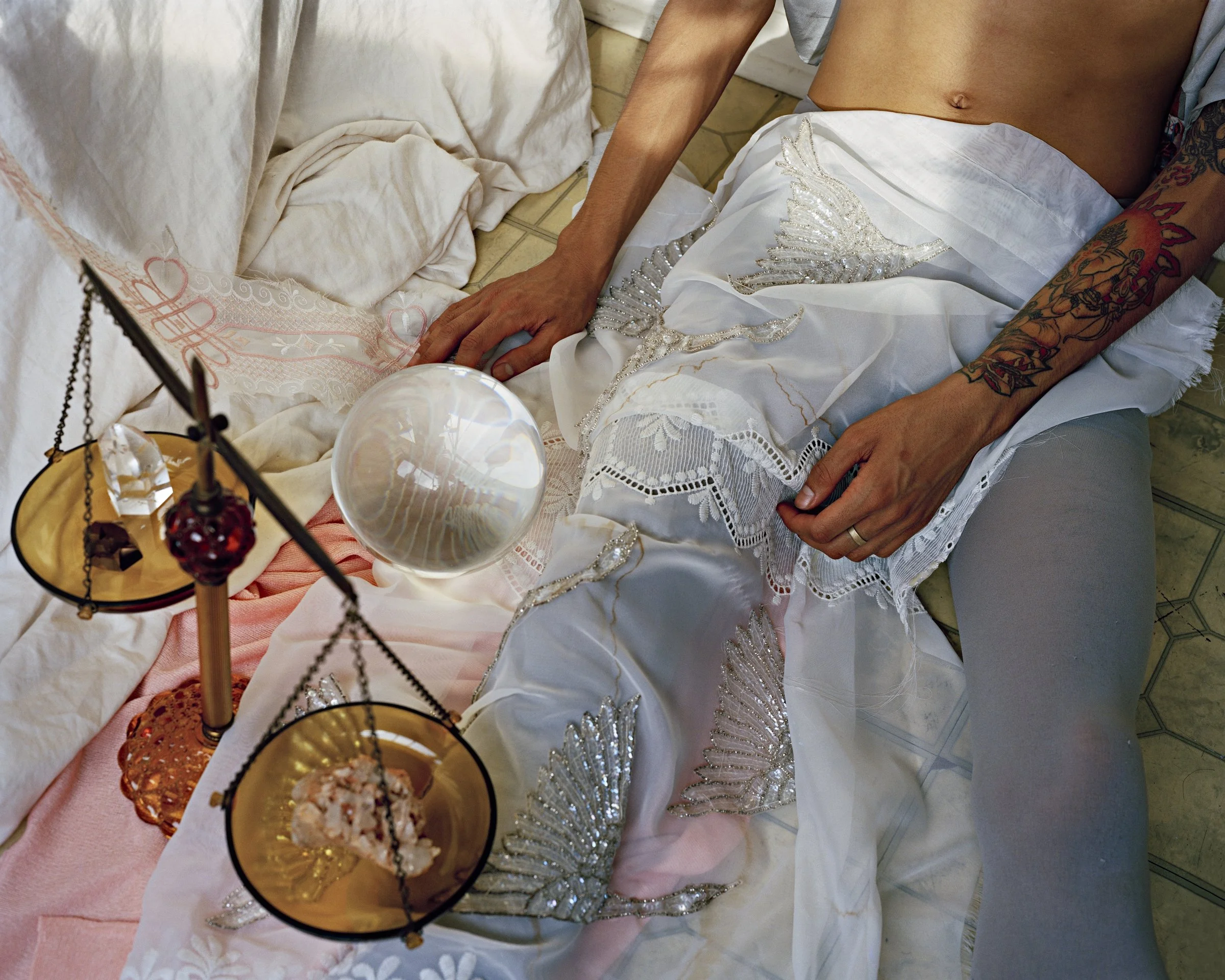
Antony and Seven Swans
vu: I love that connection of identities to objects. There is so much chaos in a lot of these images with how everything is composed, and I think that refusal to be neat and tidy really speaks to the heart of what queerness is, not in terms of sexuality, but in terms of something being at odds with everything around it. You compose objects that don't all fit neatly together. They're strewn about in all your images.
KK: Yeah, I think with the objects, some of them that are on the bodies, the way that I refer to them is as “spills.” There are a lot of things that I'm doing with the spills, but they’re often a way of externalizing something that is describing something internal. Whether that's an experience of identity, a specific story, color, or light, it’s something that I connect with with my queer identity.
vu: Yeah, the color really shines through. There is also a fair amount of morbidity and brokenness in these images. I saw one of someone with a cast around their foot in their own crutches, and they're in a cemetery at a child's grave. And then you have this image with the cast off the foot and all this shattered glass. These are also celebratory and lively because of your use of color and ornate objects. What draws my eye here are these broken cups. Did you break them apart for this picture? It looks like they were just thrown off the table.
KK: No, I didn't break them for the image. When it comes to objects that are in the images, I don’t intentionally distress anything. Sometimes the same object will come up a couple times because I did accidentally break it, and then I end up incorporating it broken into another image. There's a magnifying glass in one that is later broken in another image.
vu: There is that fantastical element that you could manipulate and construct, but you're choosing to display things as they are. What you’re documenting here is nonfiction. I wouldn't quite call it documentary, but you're telling real stories just through a more fantastical lens.
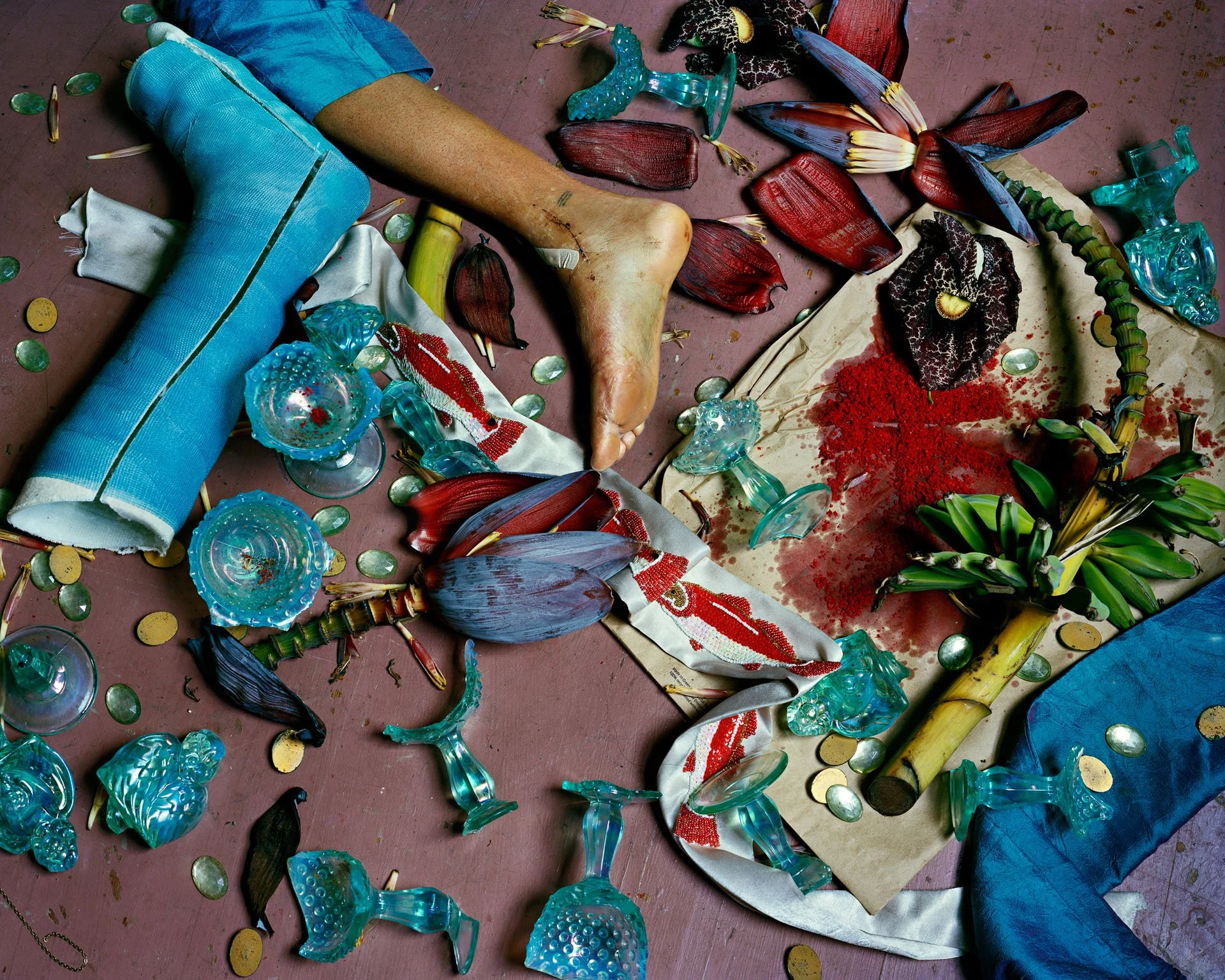
Soleil with injury from Mardi Gras
KK: I try to go into the past and pull things to the surface. So there is something here that happened with Soleil. There's also my part of this story and my interpretation. In order to show one side, I have to bring in other elements and create this visual story. It's also a way to process experiences through co-creating something with another person, which, in this case, refers to an injury. The image becomes a container for that processing. That also happens between the person and whatever intimate connection that we have while making the picture.
It’s euphoric for me to be able to make a picture like this, and to have it say something about somebody else's life, and then it also becomes something we're working on together, something that becomes a spell about our connection or a desire.
vu: I really love that. I think it's such a beautiful thing to process through creation, and that's what artists do most of the time. Whenever I see another person in a photograph, I wonder: were you co-creating with them or were they standing in for something else?
KK: There are various levels of collaboration or interest. In a literal sense, there can be objects that other people are bringing and my own objects. It’s often a combination of the both in the images. I am also really attentive to how people want to be photographed or seen—being sensitive to that and also how violent photography can be. Part of that violence for me is speed. I am a very slow maker in general, which I think is good. Although we live in a system that tells us that it's bad over and over again.
That is one of my own personal struggles is kind of dealing with those ideas of productivity and speed and my own set of values around that. This close friend of mine, Soleil, was down to work on something together about her body. For this one: the goblets, the plant life, I collected, and Soleil brought me the cast. Actually, she took it on a plane after her surgery in New Jersey to bring it back to me. I was very lucky about the color, because this is a color that I use a lot—these deep blues and cobalts.
vu: The process of being a slow maker, doing that very intentionally, and I think tha i's also a queer thing. It’s also a little bit anti white supremacist, too, because white supremacy teaches us that everything is urgent, that things have to happen now. The process is sped up, so we don't have time to really sit and connect.
KK: Yeah. Also structure and a sterile quality. I think of those things with white supremacy.
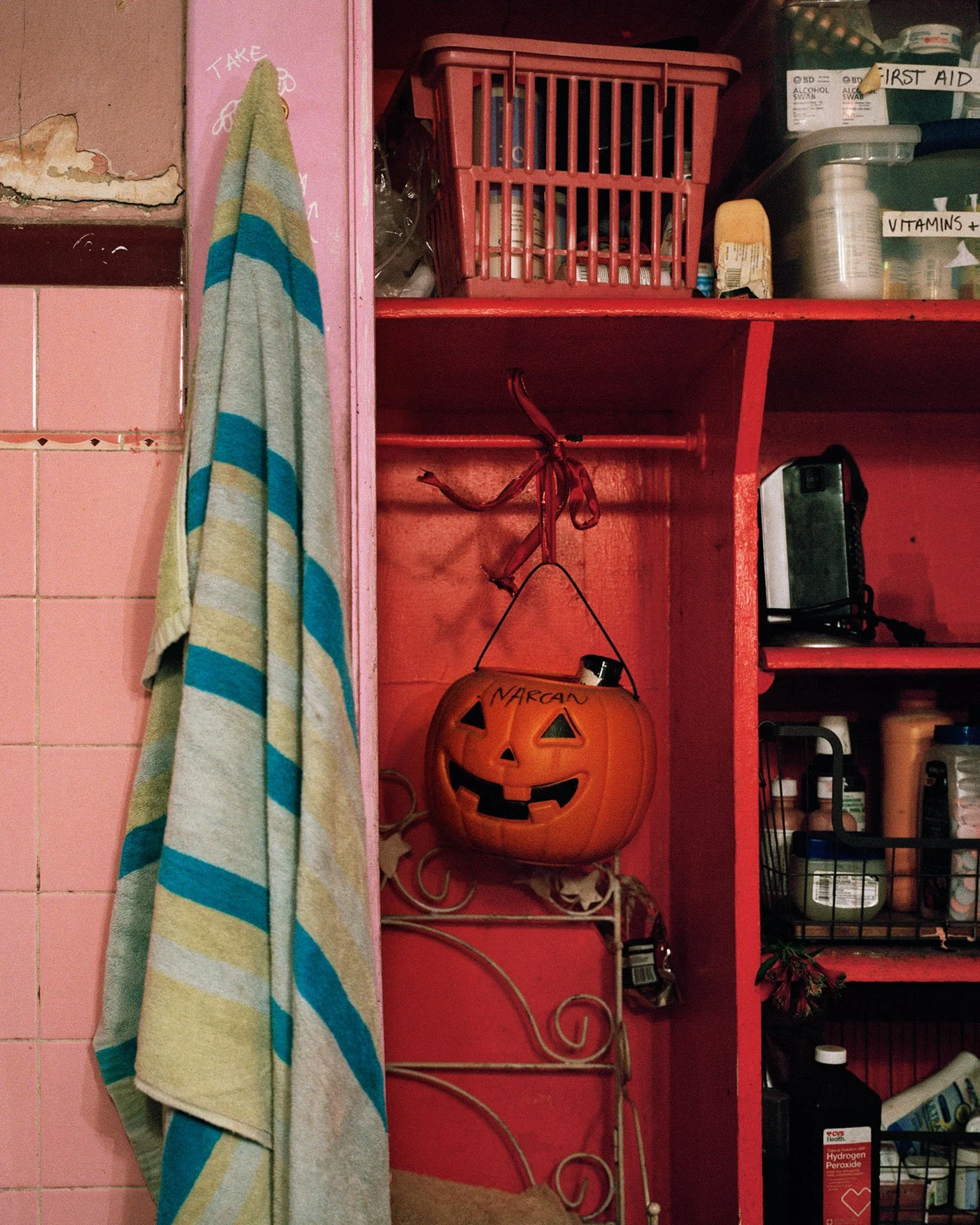
Moonhole Bathroom (Narcan)
vu: Yeah, like euphemisms. And you're not treating these images euphemistically at all. You’re creating these images really slowly, and there is no way to really take in all that's happening quickly either. You have to take your time with these images to really understand them.
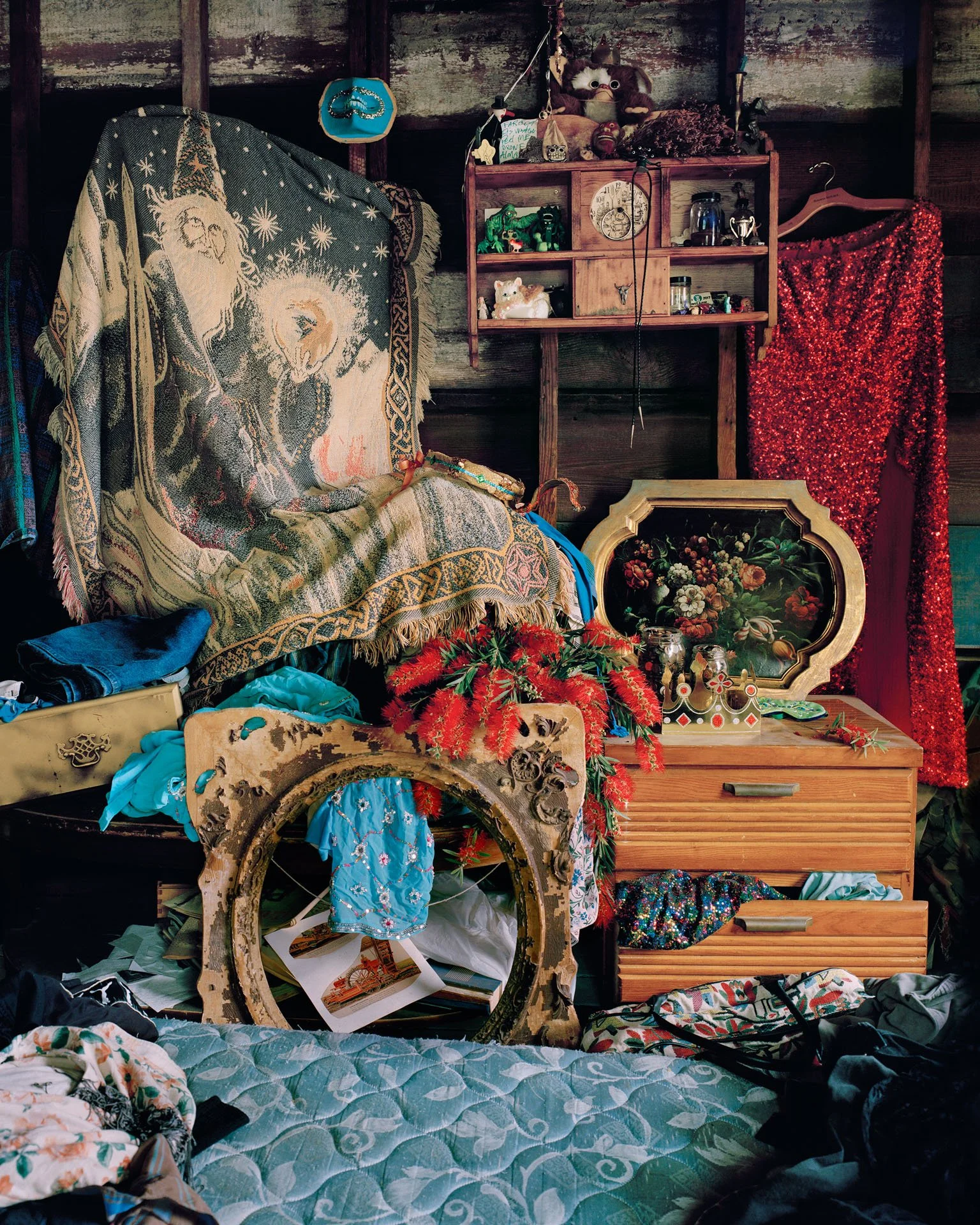
Auryn’s Shack
KK: Yeah, it definitely forces a slower look, I would say. There is something that's really pleasurable to me about those specific experiences of looking. Talking about speed reminds me of making this one. The person's space that I photographed: it was a very private space that they don't let many people in. It was this little house, kind of shack space, on stilts that you would have to climb a ladder up to get into. This is probably the second time I shot in here. I gathered the bottle brush and then we pulled out some of the frames. People often read this one as a mirror, which is kind of fun, but it's not a mirror, it's an empty frame.
vu: I think it's beautifully composed. There are all these like weird little trinkets that are just someone's own intimate personal collection. It can be really hard to get someone to open up to you in that way, even without their physical body in it. I mean, space is such a treasured thing too.
KK: There are a lot of different ways that I think about intimacy with these pictures beyond the body. Whether that's in the act of co-creating something with somebody, looking at somebody's intimate space, or us sitting around and someone pulling out a jar with a tooth and some other things that are special to them. It brings this tender experience of childhood at times too, finding people that also kind of gather little treasures. I did then and still do.
vu: The time it takes to make something like this does not always translate, but with your work, I do think that comes through. I love picture-making as a way to connect with people. You get to experiment with things neither of you would do on your own, and that is a very intimate practice.
KK: There's also a different attentiveness. There is one image that was made with artificial lighting, but everything else is natural light. So there's navigating what time of day to photograph in, which also brings this different slowness to it. I'm looking for a very specific quality of light, and I'm often not creating that, so then I have people telling me when the light is best in their space. It becomes a physical act of juggling objects and then time and light. There is a lot of maneuvering that has to happen that's probably not super visible to anyone looking at these images in order, for instance, to have this cast or have the specific time of day, or you're gonna wear this thing that your mom made in the 70s for you. And sometimes stuff just happens with my mental processing and my practice that I end up crystallizing later into an image.
Sometimes I feel like I'm doing something kind of transgressive or wrong in a way where I want to make a picture that's about this difficult thing versus the expectation of the other person that I was making an image of. There is something that I enjoy about making the picture that the other person I can tell really wants. I think that can be really healing for people. I also want to make sure I'm making this picture and trying to get closer to the heart of what it is that I'm looking for in my practice, which I think also is often a moment of when I really identify with or connect with something.
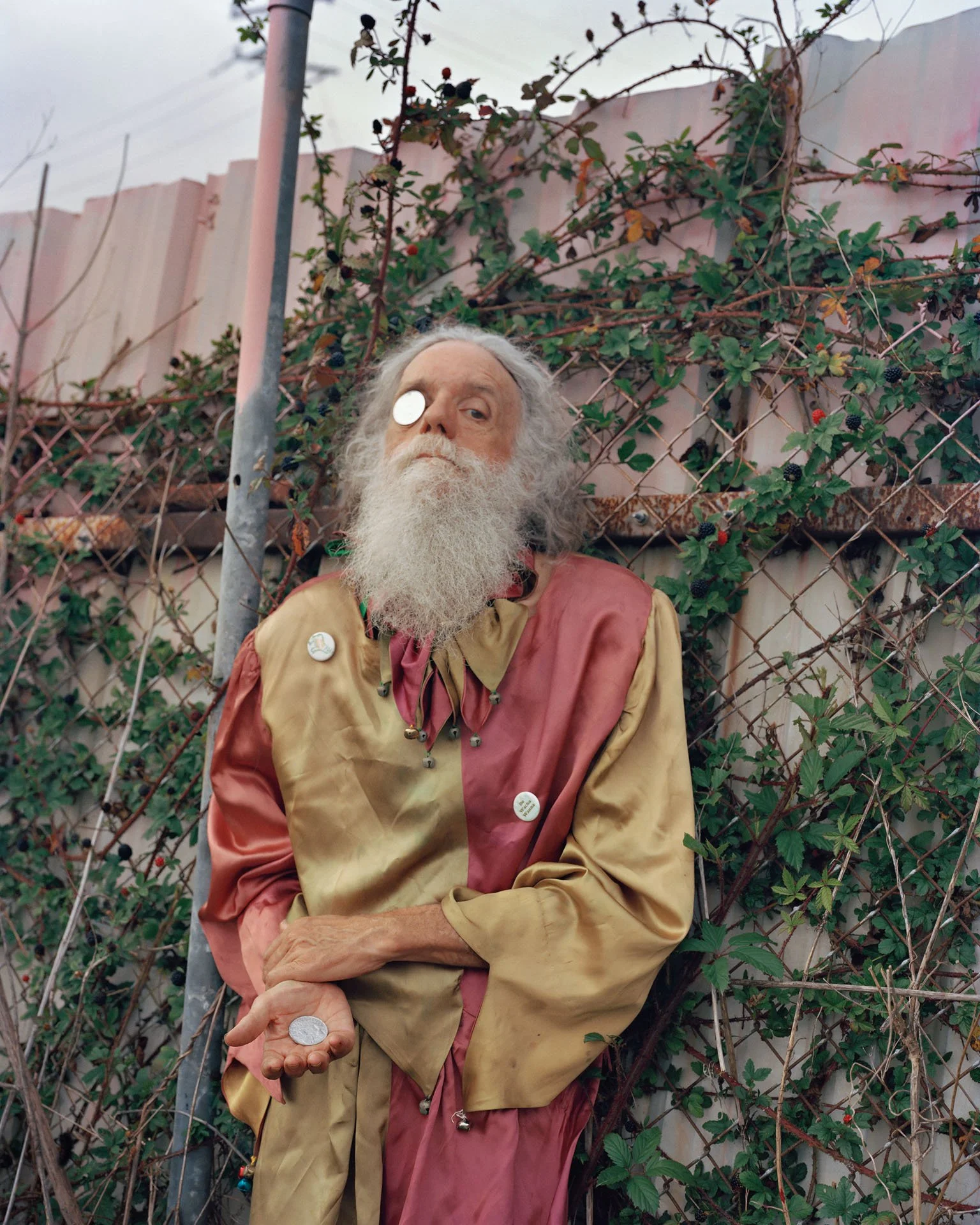
John with Coins
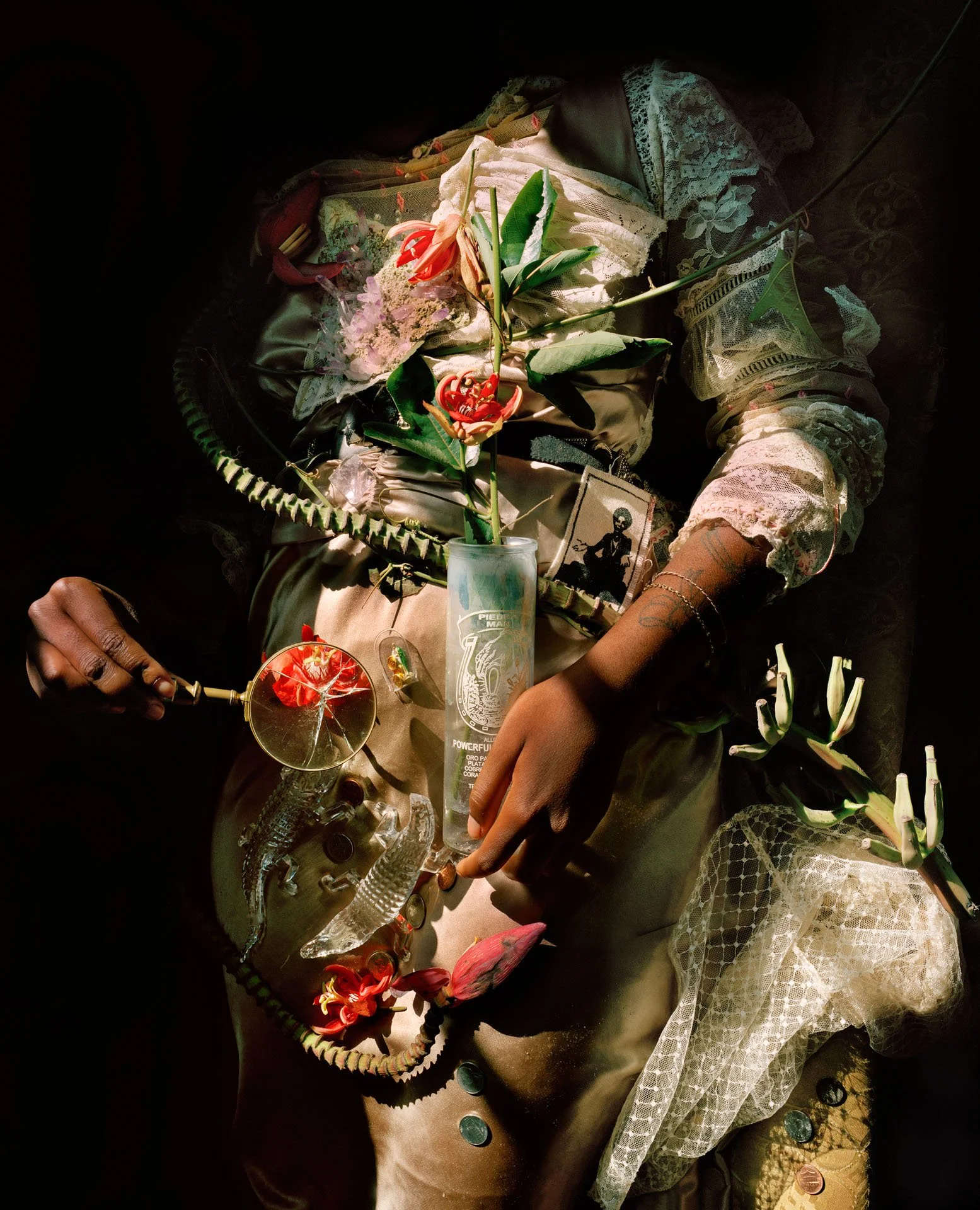
Erica Magnifying Passionflowers
vu: What is that wrapped around Erica's body?
KK: Banana blossoms. Collected plant life becomes specific to wherever it was shot, in this case, New Orleans.
This is another one shot with the grant. I really like the red eyes on this patch that they had on their jacket, so I ended up positioning that to connect with their gaze and also feel protective even when they are in a very vulnerable state in this image. This was right before they had a double mastectomy because of cancer. And then this vial was referencing the way that their urine would turn red during chemo. Then there are a couple images which have flies, which I can't plan for a fly to be in there, but I'm always very happy when they are. I love the tooth gem, too.
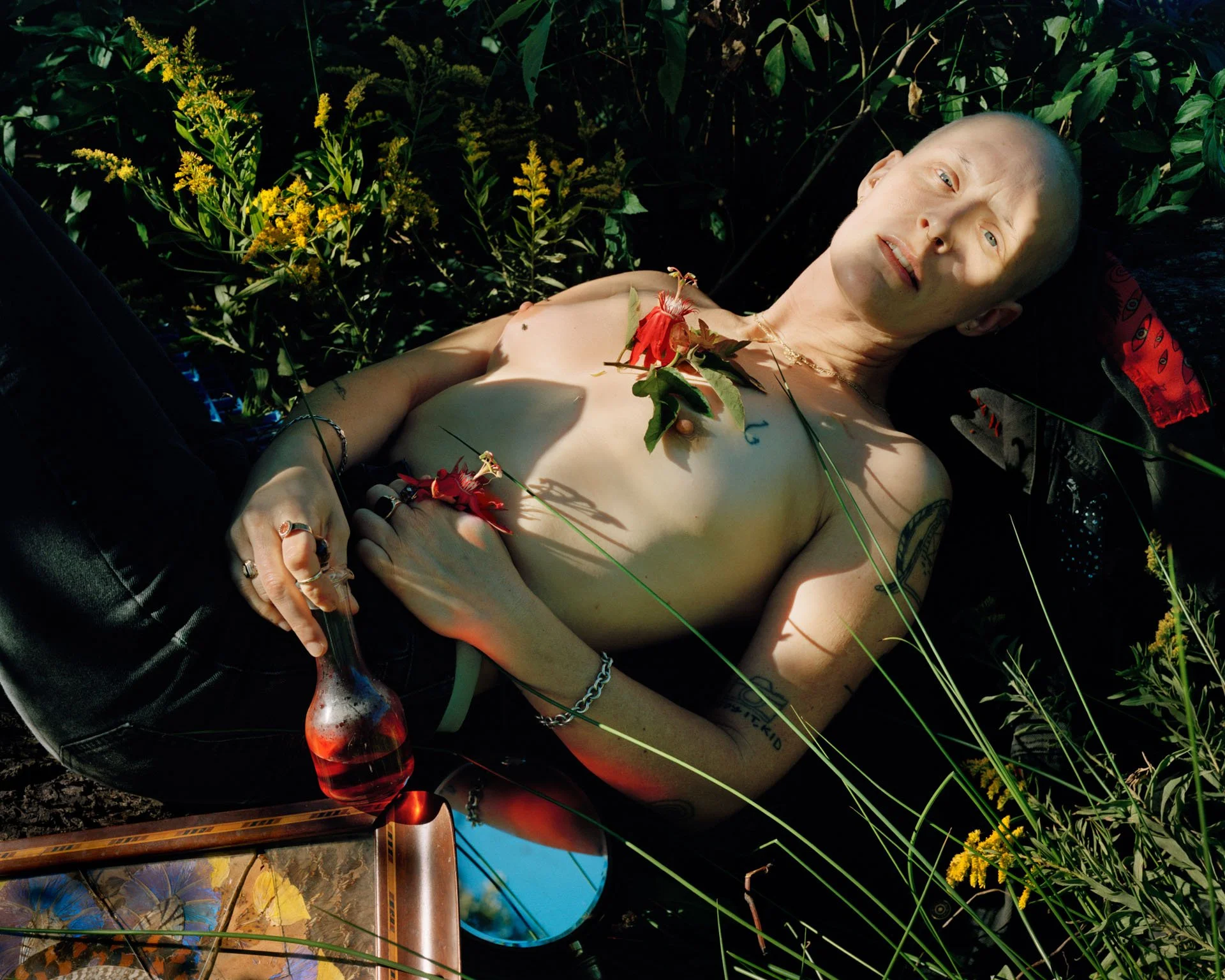
Annie Before Surgery
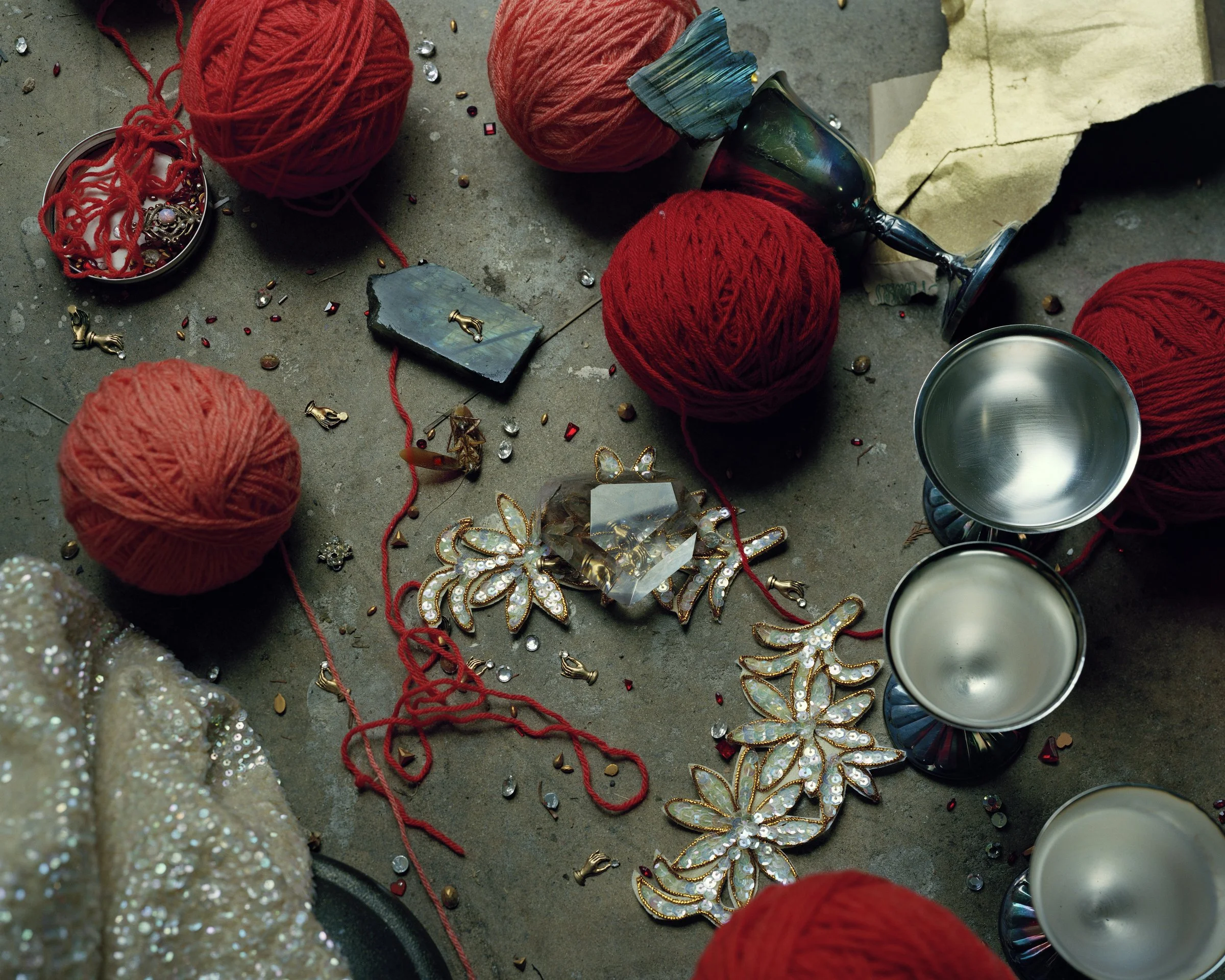
Four of Cups Idle Hands
vu: Oh, yeah, that is pretty. You don't really manipulate these images at all after. You find little gems.
KK: It's some combination of planned and unplanned. This one: there's this red gem behind the cockroach wing. I just found the cockroach there, which was in the apartment I was living at the time. And that was a piece of paper bag I was using to spray paint on top of to make something for a Mardi Gras. The textures of things end up having a lot of meaning for me. Like throwing in this sequin gives it the little iridescent blotches of color. Anything that people use as ornamentation on their body is really interesting to me, and there are a lot of tattoos that come up throughout the images.
I think I'm still figuring out a lot about my practice and process in general: why these are things that I value or why they are seen at times as frivolous or different. I think that’s also often a dig at the feminine—the idea of frivolity when it comes to beauty.
vu: Okay, so this one, I'm very curious about it.
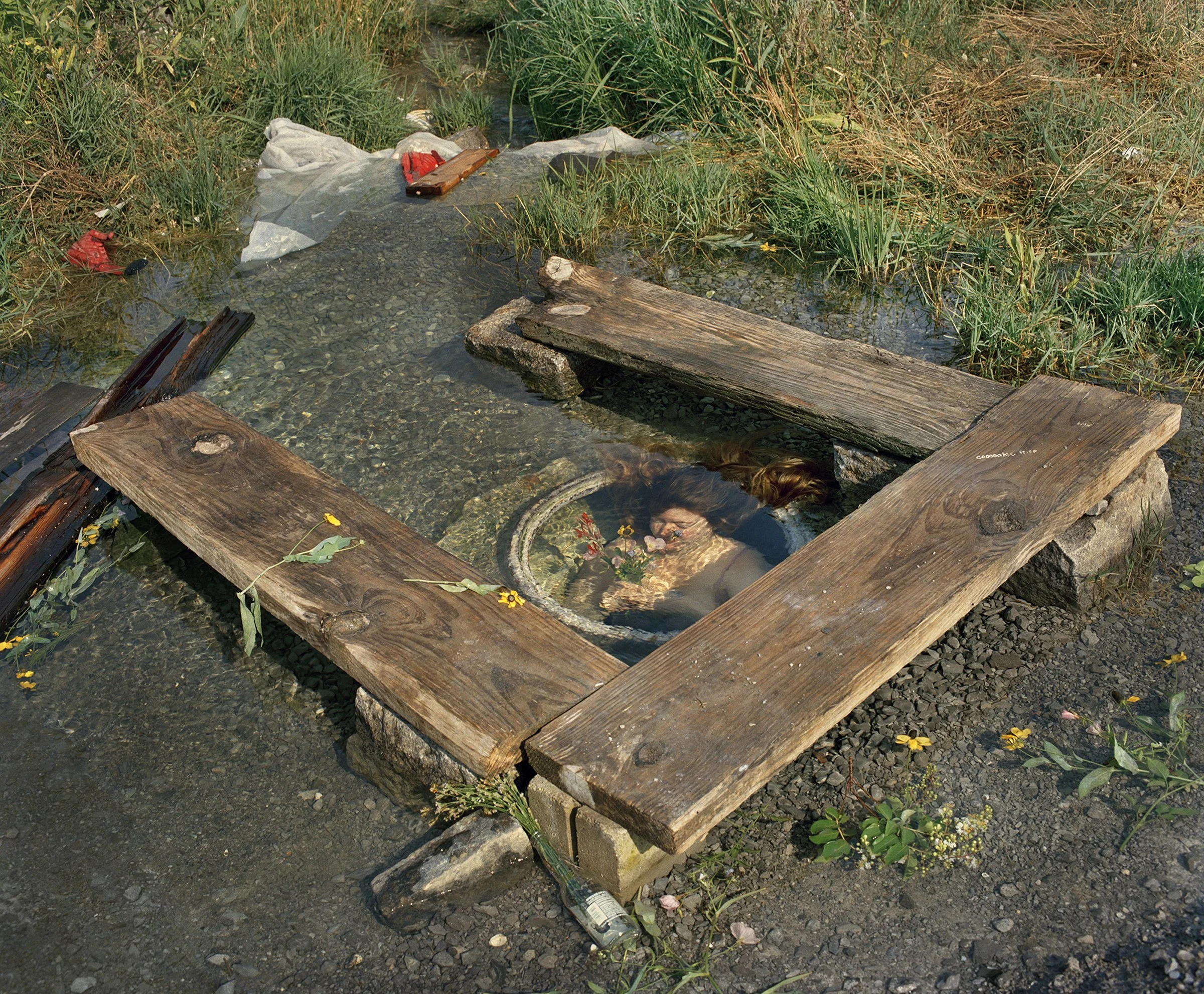
Elysian Spring
KK: That’s me. I'm in there.
vu: Are these your shoes?
KK: No, those were shoes that were there. There is a broken water main behind a Lowe's that has fresh water coming out of it. The Sewerage & Water Board is a giant nightmare in New Orleans. But the punks put these boards up, and they would come here, drink beers and hang out. Houseless people would come here to wash clothes or their bodies. So it’s a convergence of a lot of different uses for this water. I call it Elysian Spring because it's on Elysian Fields, which is a major street in New Orleans. And it's also this man-made-accidental-infrastructure-issue spring that is used by people in various communities. That’s not the most important aspect of it, but it's definitely a part of the image.
vu: It has this kind of morbid feel to it. Did you intend for it to feel like that? Or what was your thought process behind getting in the water?
KK: Actually, it was pretty pleasant because it was very hot.
Part of it is honestly quite simple: I like circles. They repeat in a lot of the images. You’ll find circles, magnifiers, a broken cup creates a half circle, the coins, the eyes. There are little containers. microcosms, little worlds that I’m finding and making within the image.
vu: You choose the word “container” rather than “frame.”
KK: Yeah, I don't like” frame” for some reason. Maybe because it feels so specific to art or something when I'm not trying to reference art with my art necessarily—more so symbols.
vu: There are also a lot of flowers present in your photos. And I'm curious about your interest in floral life: what does it represent to you? How do you use flowers as symbols?
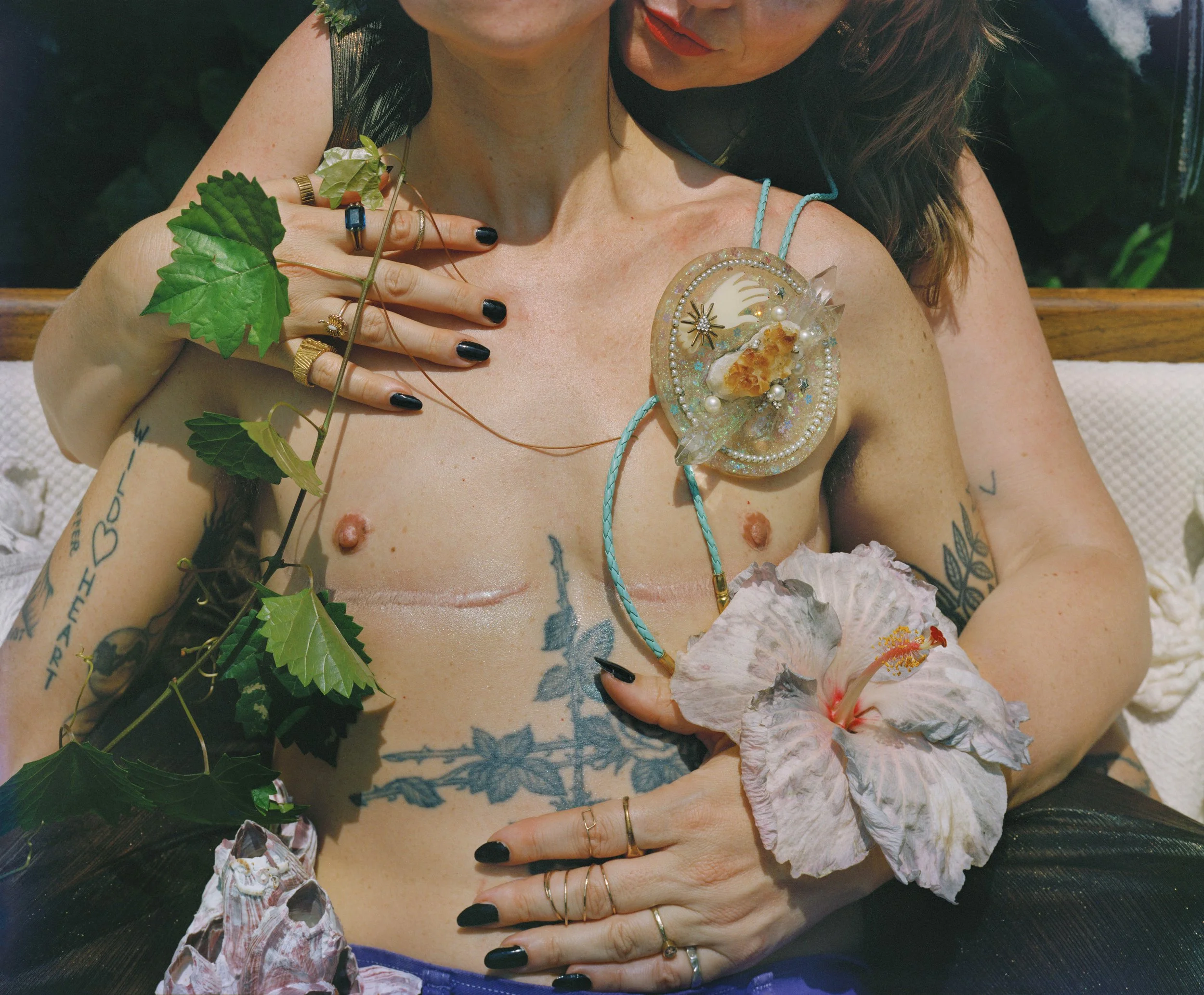
Dine & Han
KK: Sometimes there are objects in the images that other people bring, sometimes there are things that I bring, or sometimes there are things that were given to me or given to another person. So there's this gift economy in it. That's a passion flower from Zach's garden. Once cut, passion flowers don't last long. I’m driving these flowers to try to make this juggling act of a picture. But in terms of what they do in the images, some of it is color-related, some of it is that I'm bringing something of the natural environment into the picture. What do you think the flowers do?
vu: They are often on figures who are laying down. I get this feeling of laying flowers at someone's grave, and maybe it's just because of that one image in the cemetery that could have tainted my view.
KK: There is another torso image that feels like a grave in a way. Pictures kind of are memorials or graves. That is one way I talk about them. Memory is often mournful. This one makes me think of decay. These flowers were gathered on the summer solstice, too. A lot of it does have to do with memorial, time passing, and with creating the image: a desire to hold on to something and to adorn a person that I care about who is sometimes already adorned in tattoos. I also think about sex organs with plants, and some of the images feel like limbs too, like the banana blossoms feel like limbs.
vu: In that image of Erica, the banana blossoms feel like a spinal cord wrapping around her body.
KK: Yeah, there are a couple of images that I feel do have this almost medical quality to them where we are peering into or at the body. And she has the passion flower on her body and a magnifier there. So it's almost like we're seeing into her in some way. And reds and pinks connect with this internal body space.
vu: It’s reminiscent of blood and bleeding. These flowers are bleeding out onto this fabric. Maybe it's just me and my obsession with sex, death and rebirth, but I do think a lot of queer identity does have to do with those things. Coming out operates not as a single act, but a process of going through multiple deaths and rebirths of self-identification in a lot of ways. That can happen both just within oneself spiritually and also beyond the self socially.
KK: God, so it’s happening all the time.
vu: I know. And I think it is a very central part of queer identities and how people move through the world generally. I have mourned who I thought I was going to be growing up since fully realizing and accepting who I actually was later on. The way that our minds change about our identities is so prevalent in your work because of the layering that you do, especially with plant life. So to answer your earlier question, your use of plant life has a lot to do with sex, death and rebirth.
KK: Yeah, I feel that too along with the memorial part of it, which to me is also connected to the physicality of film. I don't know how that's connected, but it feels connected to me—being able to hold something that's been struck by the light of this flower, you know? These images contain echoes of things.
vu: It's poetic how a photograph holds a specific moment in time in these chemicals.
KK: And minerals too. Minerals, bones and silver. It’s all occult, if you really think about it. Light, mineral and bones.
vu: So that's your practice then. You're not a photographer. You're a scholar of light, minerals and bones. This begins to answer my next question: why shoot in film?
KK: Yeah, actually that's awesome. I love optics too: lenses, glass, mirrors, all of it. The physicality of shooting with an all-mechanical camera that doesn't need a battery. Well, most of the ones, they do have a battery, but not all. Something that is just glass, mirrors, minerals, bones, and light. And to be able to turn it into silk is another level of alchemy. We’re making prints with light.
I also like having a physical object that has been touched by light, which feels different than digital capture with a sensor. That physicality feels important to me even though they are digitized and made as digital prints afterwards. Part of that is more connected to the magic of photography: that physicality, and that experience of light striking the negative. There's also a different process of looking that happens on ground glass. It’s a different experience in real time also to connect to whatever or whoever I'm photographing.
There are a lot of references to picture making, archiving, and things that I think of as a microcosm for my process overall. The act of looking comes up sometimes in some of the images through different magnifiers.
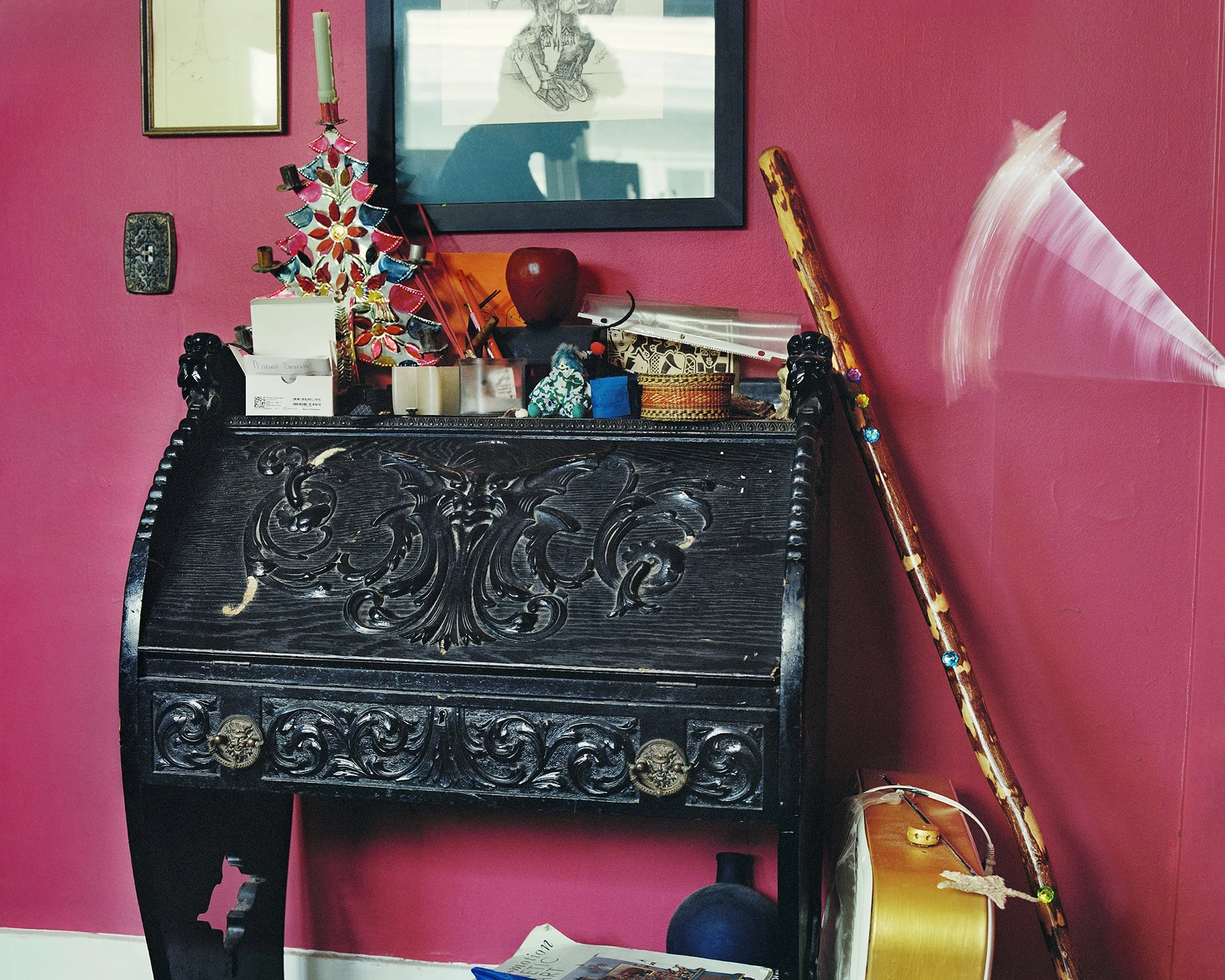
Jeanne’s Cabinet
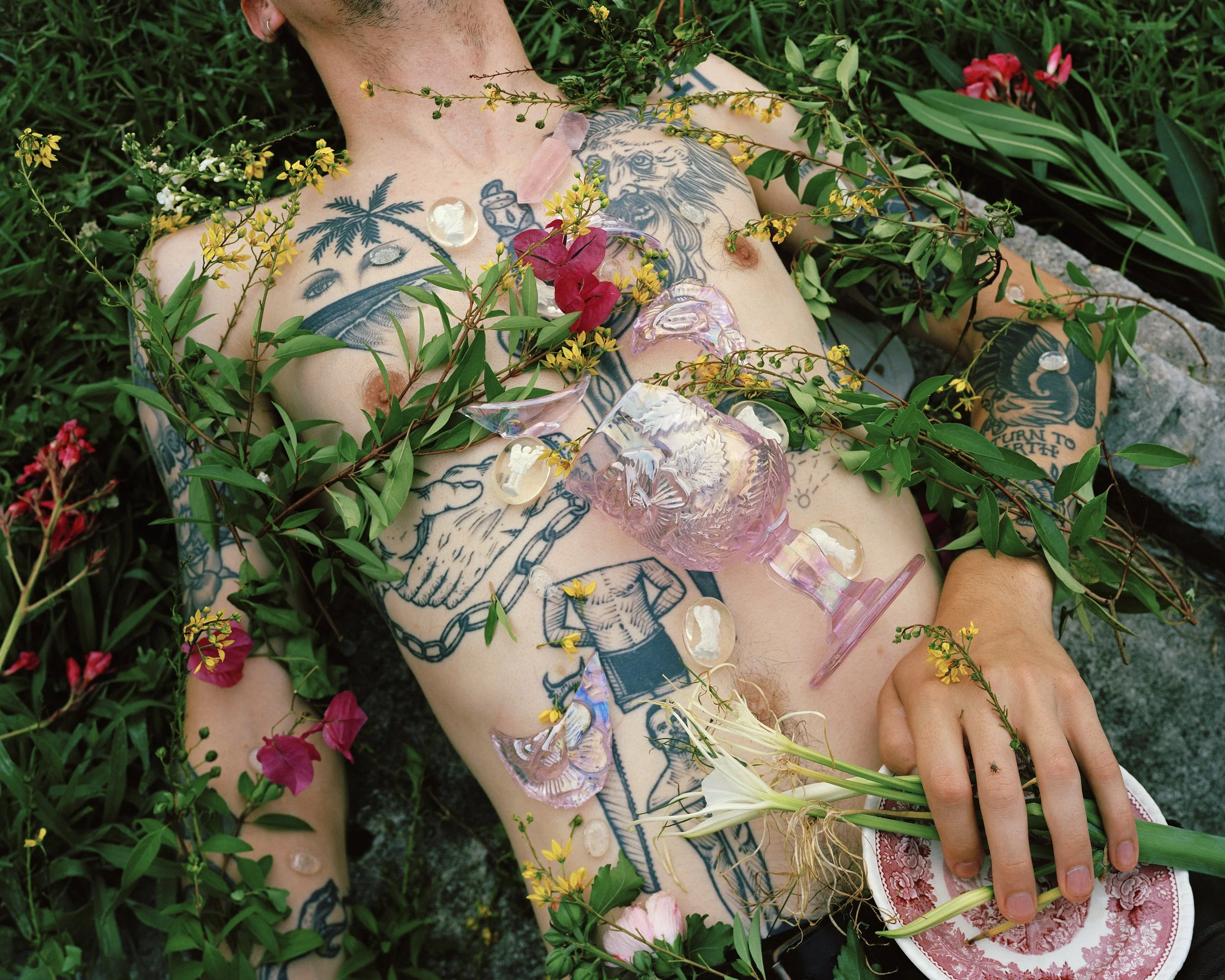
Jeremy with Broken Goblet and Angels
vu: I love that element of physical touch. There is something to say about something that exists in the real world and something that exists as a pixel.
KK: Yes and then, of course, the detail. Some of the images I printed on fabric, some of them on paper, some to scale, so I’m able to see detail. I also like that I have to take some time with either developing the film or waiting to get it back. Some things come up that I did not expect. So there is that element of distance in time and space with the film, which allows me to mentally process the images in a different way.
vu: How are you looking to continue your work on this project?
KK: I’ve gotta make some more pictures. But right now, I’m working on a multimedia piece with some family archives.